Why every e-signature could soon be contestable
e-Signatures
Future of agreements
Legal disputes
19/05/2026
13 min read

16 July 2025
6 min read
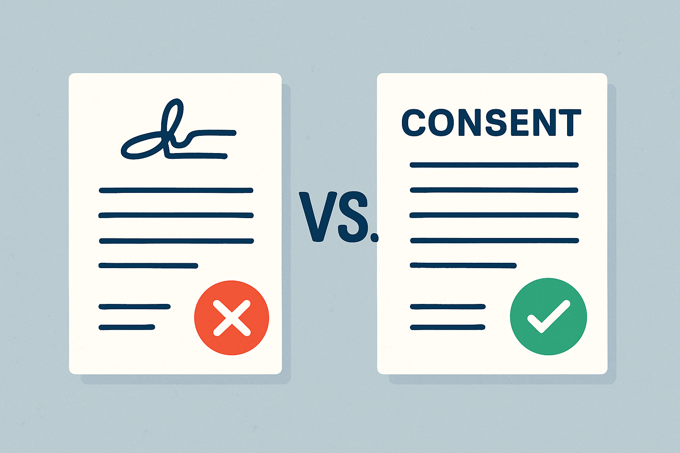
Electronic signatures are fast, efficient, and legally recognised. But legal recognition alone does not mean someone truly agreed to what they signed. In regulated industries, especially in the UK and EU, there is an important distinction between simply signing a document and giving informed consent.
As the FCA, SRA, and other regulators shift their focus toward fair treatment, comprehension, and accountability, businesses must ask: does our process prove understanding or just agreement?
An electronic signature (or e-signature) is any electronic process that indicates acceptance of an agreement. This could include:
Under UK law (such as the Electronic Communications Act 2000) and EU law (eIDAS Regulation), electronic signatures are legally binding if they meet certain conditions. They are widely accepted for general business transactions, internal agreements, and low-risk authorisations.
But legal validity is not the same as informed agreement. A signature confirms that someone has taken an action, not that they understood its meaning or implications.
Informed consent means that the person agreeing:
This principle is central in regulated environments such as financial services, legal advice, healthcare, and data protection. In these fields, the consequences of misunderstanding can be significant.
For example:
In these cases, the bar is higher. You cannot rely on a signature alone. You need to prove the signer understood what they agreed to.
Let us look at how the two concepts compare:
| Topic | E-signature | Informed consent |
|---|---|---|
| Legal basis | UK Electronic Communications Act, eIDAS | FCA, GDPR, SRA Codes, Consumer Duty |
| Focus | Formal acceptance of terms | Understanding and agreement |
| Proof | Signature log or IP record | Clear evidence of comprehension (e.g. summaries, confirmations, recorded interactions) |
| Use case | Simple contracts, internal approvals | High-risk, regulated, or client-facing agreements |
A landmark example is Belsner v Cam, which questioned whether a client’s consent to legal fees was valid if they did not understand the basis of the agreement. The case shifted attention away from signature and toward fairness and clarity.
Another important legal influence is the Consumer Contracts Regulations 2013, which require that consumers receive clear and comprehensible information before entering into distance contracts. Failure to provide such clarity can result in unenforceable agreements.
Regulators are increasingly focused on outcomes, not just processes. The expectation is that clients and consumers are placed in a position to make informed decisions. That means:
With the FCA’s Consumer Duty, firms must show that they took reasonable steps to ensure understanding. Under GDPR, vague or hidden terms can invalidate consent. The SRA continues to stress that solicitors must tailor their communication to each client’s level of understanding.
Ticking a box is no longer enough. Nor is capturing a quick signature. Firms are now expected to demonstrate that they prioritised clarity and comprehension at every stage of the agreement process.
Section 8 of the FCA’s Consumer Duty outlines the expectation that communications must support consumer understanding. This means going beyond simply providing information — firms are expected to ensure that the way information is presented actually helps the customer understand it and make effective decisions.
Using traditional e-signature platforms may meet the requirement to provide documents, but they often do little to promote understanding. They do not offer checks for clarity, allow meaningful interaction, or confirm that the recipient processed the content.
A consent-first platform like  i agree directly supports section 8 by:
This approach turns communication into an active process that helps consumers genuinely engage with the content. By aligning with section 8 in both spirit and execution, i agree helps firms meet their Consumer Duty obligations while delivering a better client experience.
To learn more, see how i agree supports legal and regulatory compliance.
Traditional e-signature platforms are designed for speed and convenience. Most do not address comprehension. They:
This creates risk:
Even if you have detailed terms and a clean signature log, that does not show the user actually processed or reflected on the agreement. It just shows they clicked.
To meet higher standards, informed consent should be:
This is exactly how i agree works. Instead of asking someone to blindly sign a document, we:
The recorded confirmation is designed to make the most of the production effect, a cognitive principle that shows people are more likely to remember something when they say it out loud. This reinforces understanding and improves client recall later. Combined with plain language and audio delivery, it creates a more inclusive and legally defensible record.
To learn more, see the science behind i agree
A consent-first system is not just a compliance safeguard — it is a better experience for your clients.
Firms using i agree see benefits such as:
This approach is particularly valuable in:
By moving beyond signatures, firms can show they are acting transparently and in good faith. That builds trust with clients and confidence with regulators.
Electronic signatures are convenient. But they were never designed to prove comprehension. If you work in a regulated environment, or if fairness and clarity matter to your business, a signature alone is not enough.
Regulators expect more. Clients deserve more. And modern platforms like i agree are built to deliver it.
To learn more, visit our FAQs or see how i agree supports legal and regulatory compliance.
i agree helps businesses prove their clients truly understood what they agreed to — not just that they signed something.
Explore this topic more with our blog about what is informed consent and why should you care
An electronic signature records that someone agreed to something. Informed consent shows they understood it. The key difference is evidence. A signature proves an action. Informed consent proves the person received, processed, and confirmed key information before agreeing.
Yes, electronic signatures are legally valid under UK law, including the Electronic Communications Act 2000 and eIDAS principles. However, legal validity does not guarantee fairness or understanding. Firms may still need to demonstrate that the signer understood the agreement, especially in regulated contexts.
Regulators like the FCA and SRA now focus on outcomes, not just process. They expect firms to ensure customers understand what they are agreeing to. This shift reflects concerns about hidden terms, vulnerable customers, and fairness, particularly under frameworks like Consumer Duty and GDPR.
Most e-signature platforms capture a signature but do not confirm comprehension. They do not show whether the user read key terms, understood risks, or engaged with the content. This creates compliance risk if a customer later claims they did not fully understand the agreement.
It involves clear, structured communication and active confirmation. This can include plain-language summaries, layered information, audio or video explanations, and prompts asking users to confirm understanding. The goal is to make the agreement process interactive and evidence-based, not passive.
A consent-first approach reduces disputes, strengthens compliance, and builds trust. It provides stronger evidence if agreements are challenged and helps firms meet regulatory expectations. It also improves customer experience by ensuring people feel informed rather than confused when they agree.