Rising SRA reports show why client understanding matters
Contract News
Recent News
Reducing Disputes
20/05/2026
15 min read

10 February 2025
7 min read
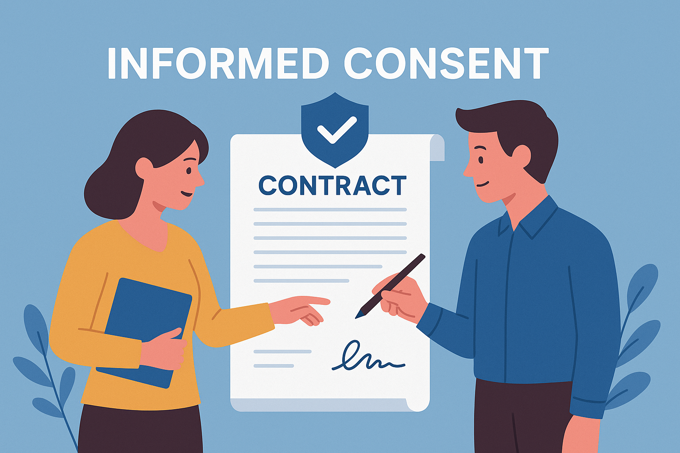
Imagine this: You sign a contract for a new service. The salesperson is friendly, the price seems reasonable, and you skim through the agreement before signing. A few months later, you realize you’ve been charged hidden fees. When you challenge it, the company points to a clause buried in the fine print.
But here’s the kicker—recent court rulings suggest that if you weren’t properly informed, that contract might not even be enforceable.
That’s where informed consent comes in.
Informed consent is not a new concept—it has been a cornerstone of medical ethics for decades. In healthcare, patients must be given clear, comprehensive information about medical procedures, risks, and alternatives before they can agree to treatment. Without informed consent, a doctor performing a procedure could face legal consequences, even if the patient signed a consent form.
But in recent years, the idea of informed consent has been making its way into the wider legal world, particularly in contract law, consumer rights, and data privacy.
Why? Because courts and regulators are recognizing that simply signing an agreement doesn’t mean someone truly understood it.
Just like a patient needs to know what a surgery involves before agreeing to it, a business or consumer needs to fully grasp the terms of a contract before being bound by it.
For consent to be legally valid, it must be:
This shift in legal thinking means that contracts are no longer just about what’s written on paper—they are about how well the other party understood what they were signing.
And if you can’t prove that they truly understood? Your contract might not be enforceable.
For consent to be informed, it’s not enough for information to exist—it has to be presented in a way that people can reasonably understand and given to them in a way that ensures they actually see it.
That means:
Being informed isn’t just about having access to the information—it’s about having the chance to process it. If a contract is too complex, deceptive, or rushed through, then consent isn’t truly informed.
Consent isn’t just a checkbox—it’s a genuine decision made freely.
A contract should never be signed under:
If someone wasn’t given enough time or explanation to fully grasp what they were agreeing to, is that real consent? Courts are starting to say no.
For years, companies have relied on long, complex contracts to protect themselves—but courts are shifting in favor of consumers and businesses who weren’t properly informed.
Recent legal rulings show the importance of informed consent:
2024 | Johnson vs. Firstrand Bank Ltd
Motor dealers that failed to specifically disclose commissions when arranging finance had breached their fiduciary duty to act in customers’ best interests.
"Terms buried in fine print may not be enforceable, even if the contract was signed."
2024 | Digital Markets, Competition, and Consumers Act
This Act strengthens consumer protection by introducing stricter rules on misleading practices and reinforcing the need for complete clarity in consumer contracts.
2022 | Belsner vs. Cam Legal Services
In this landmark case, the Court of Appeal held that merely signing a document did not provide "informed consent" and that solicitors could not charge additional fees without ensuring clients fully understood the agreement.
2024 | Oakwood v Menzies
"The sign-up process the defendant used was not fair, and they were not properly or adequately 'informed'. Simply requesting a 'click' to e-sign the document was insufficient evidence of consent."
Regulatory bodies are reinforcing the need for clear, informed agreements.
Financial Conduct Authority
"It’s not about presenting a customer with a form and saying, 'Tick this box to show you understood it.' "
Kate Tuckley, FCA Head of Consumer Investments
Solicitors Regulation Authority
"We ask the firm to show us that the client has given informed consent to the arrangement."
General Medical Council
"All patients must be supported to make informed decisions about their care."
Regulators are making it clear: informed consent is no longer optional—it’s a requirement.
So what does this mean for businesses? If you want your contracts to hold up, you need proof that consent was informed.
No proof? Your contract could be worthless.
At  i agree , we believe contracts should be clear, fair, and enforceable. If you can’t prove informed consent, your contract isn’t worth the risk.
Want to make sure your agreements hold up? Let’s talk.
Explore how i agree can help you create contracts people actually understand.
Check out our FAQ or try our demo to see how it works
Informed consent means the person agreeing has been clearly given the key information, understands it, and makes a voluntary decision. It goes beyond a signature by focusing on real comprehension of terms, risks, and obligations before agreement is made.
Because a signature alone doesn’t prove understanding. Courts and regulators increasingly expect businesses to show that clients genuinely understood key terms. Without this, agreements may be challenged, disputes may rise, and contracts can even become unenforceable in certain cases.
Consent is informed when information is clearly presented, easy to understand, and properly highlighted. It also requires that the person has time to review, ask questions, and make a free decision without pressure or misleading communication.
Courts and regulators are shifting focus from signatures to understanding. Cases like Belsner v Cam and rulings such as Johnson v Firstrand show that hidden or unclear terms may not hold up, even if signed. Regulators now expect evidence of clarity and comprehension.
Traditional contracts often rely on dense text and signatures that don’t confirm understanding. Many people don’t read or fully grasp terms, which creates risk. Without proof of comprehension, businesses may struggle to defend agreements if disputes arise.
i agree support informed consent?
i agree focuses on clarity and proof of understanding. It uses plain-language summaries, video and audio explanations, and confirmation steps to ensure users actively engage. A full audit trail captures how consent was given, making agreements more transparent and defensible.