Rising SRA reports show why client understanding matters
Contract News
Recent News
Reducing Disputes
20/05/2026
15 min read

26 January 2026
14 min read
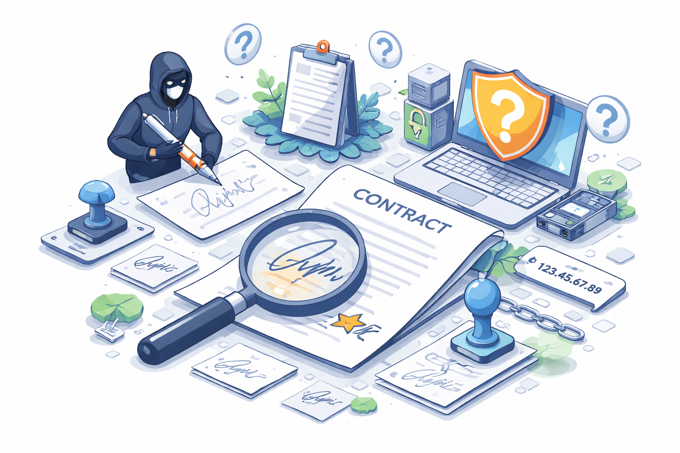
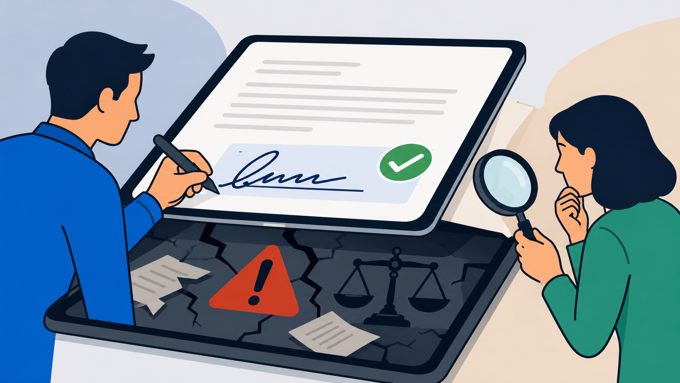
In the legal world, a signature is often treated as the ultimate proof of agreement. Whether it’s an ink scribble at the bottom of a contract or a digital click on “I agree,” businesses and lawyers have long relied on signatures to enforce deals. But what if that confidence is misplaced? The truth is that a signed document isn’t always the airtight evidence we imagine. Signatures can be forged or affixed to the wrong document. Digital signatures can be applied by the wrong person. And even an authentic signature says nothing about whether the signer truly understood the agreement. In this blog, we’ll explore why a signature alone is not good enough – and how a more modern approach can fill the gaps.
Yes – but only in a basic sense. A signature (physical or electronic) generally indicates an intention to be bound by the document. Courts and laws do recognize that a signed contract is valid in most cases. For example, in the United States, the federal ESIGN Act gives electronic signatures the same legal status as handwritten signatures. Similarly, many jurisdictions uphold that if you sign a contract (even without reading it), you’re bound by its terms. In that limited view, signatures are “legally binding.”
The fine print: There are important caveats. A signature is legally valid only if certain conditions are met, such as the signer’s intent and the document’s integrity. The person must have signed voluntarily (without duress or deception), and the document must not be altered after signing. Critically, you also need to be able to link the signature to the person who signed it – which is why high-stakes documents often use witnesses or notaries. In other words, the law expects some assurance that the squiggle or digital mark actually came from the right individual at the right time. This is where things get tricky, because a signature itself provides very limited proof of those facts.
Legally binding or not, a signature is ultimately just a symbol of consent – not a magic security seal. The rest of this article explores how that symbol can mislead us and why blindly trusting a signed piece of paper (or PDF) can be risky.
A pen-and-paper signature – often called a “wet” signature – feels very official. Ink on paper, maybe a fancy pen, maybe a witness signing nearby. Yet this traditional ritual has some serious weaknesses. Here are a few of the problems with old-fashioned signatures:
In essence, a signed paper is just markings on a page. It might hold up in many situations, but as proof it has cracks. Modern litigation is full of examples where Person A insists a signed contract is authentic and Person B says “that’s not my signature” or “that page was swapped.” If your only evidence is the signature itself, how do you prove who’s right? Relying solely on wet signatures means relying on trust – or later, on forensic experts – neither of which is a great foundation for legal certainty.
One might hope that electronic signature technology has solved these issues. After all, when you use an e-signature service, you get audit trails, email confirmations, maybe even an IP address logged. Unfortunately, basic electronic signatures (like the kind done via popular platforms) inherit many of the same problems – and introduce new ones.
First, let’s clarify terminology: a “digital signature” can mean a cryptographic signature (where a certificate verifies identity), but in everyday use it often just means an electronic signature – like typing your name or drawing a squiggle with your mouse. Here, we’re talking about the latter. Most people using DocuSign, Adobe Sign, HelloSign, etc., are using simple electronic signatures, not certified digital certificates.
Here are some major issues with these e-signatures in practice:
To sum up, electronic signatures solved the convenience problem (no more printing and scanning), but not the trust problem. As one analysis bluntly put it, basic e-signatures let a malicious user “impersonate another signer simply by entering their name and routing the document to an email address they control.” In fact, some e-sign platforms don’t even require an account login for signers – the email link is enough. That’s hardly a guarantee of who’s on the other end.
It’s telling that even with digital signing, many businesses still resort to extra measures: sending PIN codes, requiring a known witness to also sign, or later asking “did you really sign this?” If we truly solved the identity issue, these steps wouldn’t be necessary. And beyond identity, we have yet to address another huge blind spot: whether the person who clicked “Sign” actually read or understood what they agreed to.
Let’s assume for a moment that the signature on a contract is 100% genuine – the correct person signed and nobody tampered with anything. Does that mean the contract won’t be disputed? Hardly. In practice, a vast number of contract disputes and customer complaints happen not because of forged signatures, but because of misunderstandings. The signer didn’t truly grasp what they were signing. They might have missed some fine print, not read the document at all, or misinterpreted jargon. A signature can show assent, but it cannot show comprehension.
Consider the common scenario: how often do you or anyone you know actually read every word of a terms-and-conditions or a lengthy contract? Studies have consistently found that the majority of people do not read contracts or online terms. One famous 2017 survey by Deloitte found that 91% of consumers consent to terms of service without reading a single word. In one tongue-in-cheek experiment, researchers even hid a clause offering up the user’s firstborn child in a terms-of-service – and almost everyone still clicked “I agree.” The point is clear: a signature or click is a poor indicator of informed agreement. People sign things they don’t read or understand all the time.
This lack of understanding has real consequences. Customers end up surprised by fees they “agreed” to, or employees dispute non-compete clauses they didn’t realize were in their contract, and so on. Regulatory bodies have taken notice too. For instance, the UK’s Financial Conduct Authority (FCA) recently rolled out a Consumer Duty that effectively says: it’s not enough to have someone’s signature on a dotted line; companies must ensure that customers actually understand what they’re signing up for. A signature ticks a legal box, but regulators are warning that a blind signature won’t hold up if the customer was kept in the dark. We are shifting toward a standard of informed consent, not just consent.
Here are a few questions a signature cannot answer on its own:
A signature by itself sheds no light on any of these critical issues. This is the root of countless disputes: “I didn’t realize what I was agreeing to.” From a legal perspective, a contract might still be enforceable despite someone’s failure to read it – but that doesn’t stop disputes, complaints, and broken business relationships. It also doesn’t sit well with judges or juries when a party can convincingly say they were misled or uninformed, signature or not.
The takeaway is that understanding is just as important as agreement. A contract that both parties fully understand is far less likely to end up in court or in a PR nightmare. Unfortunately, the traditional contracting process puts all the burden on the signer to read and understand, while giving the company an easy out (“well, you signed it!”). This disconnect between what the business thinks it communicated and what the customer actually understood is a ticking time bomb. It erodes trust and invites conflict.
In short, getting a signature should not be the end goal. Getting true informed consent – where the person knows what they’re signing – should be the goal. And that requires more than a signature line; it requires a better system for communicating and capturing agreement. Which brings us to the solution: changing how we approach the concept of a “contract” altogether.
What if instead of relying on a shaky signature, we could capture the whole context of an agreement? Enter the idea of the “context contract.” This is the approach pioneered by  i agree, which reimagines how agreements are formed and documented. The context contract focuses on recording not just the final signature, but the steps and information that lead up to that agreement.
How is this different from a normal contract? Think of all the back-and-forth that often happens before someone signs: explanations given by a salesperson, FAQs the customer reads, key terms highlighted in a summary, even verbal assurances like “don’t worry, this clause is just a formality.” In a traditional contract, none of that context is captured. If a dispute arises later, it’s “he said, she said” – the contract document stands alone, and any external statements may be difficult to prove. A context contract, by contrast, captures those crucial contextual elements as part of the agreement.
Using the i agree platform as an example, the signing process is very different from simply scrolling to the bottom of a PDF. Instead of relying on passive acceptance, the user is guided through a plain-language summary of the key terms, supported by short video or audio explanations that translate legal wording into human language. Crucially, the person is then recorded repeating the key terms in their own words. They say what matters, what they are agreeing to, and what they understand. By the end of the process, the individual has read the terms, heard them explained, and said them back. This turns agreement into an active, recorded moment of understanding rather than a silent click. Only once this step is completed does the process conclude that informed consent has genuinely been given.
All of those actions – viewing the summary, watching the explainer video, confirming understanding of specific clauses, etc. – are timestamped and logged. This creates a rich audit trail that shows exactly what information the person saw and agreed to. It’s not just a signature; it’s a story of how the agreement was formed. Later on, if there’s ever a question, you have evidence that “John Doe watched a 30-second video about the fees and clicked to confirm he understood the fee structure at 2:35 PM on March 3rd” rather than simply “John Doe signed here.” That is powerful in both legal and practical terms.
Identity verification improves as well. Because the context contract requires the person to actively engage with the agreement, it becomes far harder for an imposter to get through the process. This isn’t just a link that anyone can click or a name typed into a signature box. With, i agree, the individual is recorded repeating the key terms themselves. They state what they are agreeing to, in their own words, in relation to that specific agreement. This means the record of consent is inseparable from the contract it relates to. It cannot be lifted, copied, or reused on a different document, because the person is explicitly referencing the substance of the terms, not just applying a generic mark. This creates a direct link between identity, intent, and understanding in a single recorded moment. It is fundamentally stronger evidence than an IP address, an email trail, or a stylised digital signature, and that full context is preserved as part of the contract record.
Why competitors haven’t solved it: Traditional e-signature companies (like DocuSign, Adobe Sign, etc.) were built to digitize the old way of doing things – they got rid of paper, but kept the “just sign here” mentality. Some have added minor improvements (you can initial specific clauses or they’ll show a summary page), but they still largely treat a signature as the finish line. They don’t ensure the signer actually understood; they don’t record the explanatory context. In contrast, the context contract approach throws out the idea that a one-shot signature is enough. It replaces it with a series of steps designed for clarity and confirmation.
The result is an agreement that’s much more robust. From a legal standpoint, you can defend it by showing exactly how the person was informed. From a business standpoint, it builds trust – clients feel taken care of when they’re not tricked by fine print. And from a compliance standpoint, it aligns with where regulations are heading: proving that customers were treated fairly and knowingly. It’s telling that forward-thinking law firms and companies are starting to choose i agree’s context contracts over old-school e-sign tools. They recognize that a signature alone is a risk, and that capturing understanding is the future of enforceable, dispute-proof agreements.
In summary, a context contract doesn’t assume that “signed” means “understood.” It actively makes sure “I agree” really means “I understand and agree.” By documenting the context – the who, how, and what behind the consent – it closes the loopholes that traditional signatures leave open.
The humble signature, whether scrawled in ink or clicked on a screen, has carried a lot of weight over the centuries. It still has its place, but as we’ve seen, it’s far from infallible. A signed document by itself is not definitive proof of identity, authenticity, or understanding. It’s merely one piece of the puzzle. Blindly trusting signatures in the modern era is like assuming a locked door is secure without checking if the hinges are loose – it gives a false sense of security.
Legal professionals and businesses are waking up to these realities. Cases of forgery and fraud show the cracks in the system, and consumer protection trends are demanding more transparency and proof of comprehension. The good news is that we don’t have to throw our hands up in despair. By evolving from signatures to contextual agreements, we can preserve the ease of making deals while eliminating much of the ambiguity and risk. The context contract approach championed by i agree is a prime example: it shows that we can have agreements that are both convenient and trustworthy.
In the end, the goal isn’t to get rid of signatures – it’s to bolster them with better evidence. Think of a signature as the tip of an iceberg; what really counts is the mass underneath the surface: the understanding, the intent, the true meeting of the minds. That’s what needs to be captured. So the next time someone asks you, “Is a signature legally binding?”, you might answer: “Yes, but let me tell you why a signature alone isn’t proof of much.”
Internal links
Yes, signatures are generally legally binding when they show intention to agree. This includes wet signatures and electronic signatures. However, a signature alone does not prove everything. It may not prove identity, understanding, or whether the document was properly explained before signing.
Not always. A signed document can be strong evidence, but it may not answer key questions such as who signed, whether the document was altered, or whether the signer understood the important terms. Stronger evidence often requires a clear audit trail.
Yes, signatures can be forged, copied, scanned, or reused on the wrong document. This is one reason why signatures alone can be weak evidence, especially where there is no witness, identity check, secure process, or reliable record of what happened.
Electronic signatures can provide useful evidence, such as timestamps and audit logs, but they are not automatically foolproof. If identity checks are weak, someone else may be able to sign using a link or email address that was not properly verified.
No, signing proves acceptance of a process, not understanding. People often sign contracts or click accept without reading or absorbing the terms. That is why businesses increasingly need evidence that key terms were explained clearly before agreement.
A context contract records more than the final signature. It captures what the person was shown, how key terms were explained, what they confirmed, and the surrounding evidence of understanding. This creates a stronger record of informed consent.