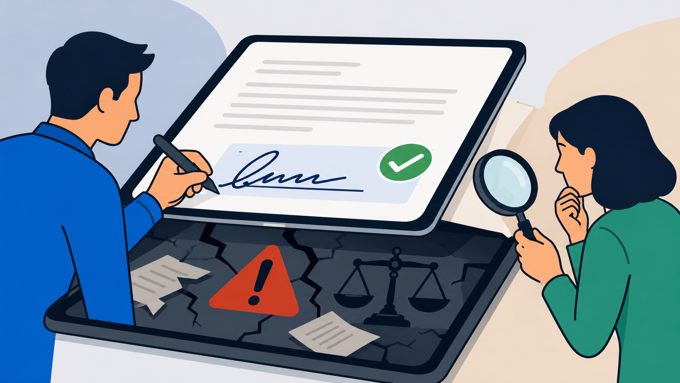
Why every e-signature could soon be contestable
e-Signatures
Future of agreements
Legal disputes
19/05/2026
13 min read

15 December 2025
14 min read

Law firm decision-makers are facing a new reality: a signed contract doesn’t guarantee a client’s understanding. In the UK legal industry, client complaints are rising, and they’re often rooted not in bad lawyering but in miscommunication and unclear consent. It’s no longer enough to get a signature on the dotted line – regulators, courts, and clients now expect real informed consent and clear communication. This blog dives into why “I agree” isn’t enough on its own, and how focusing on client understanding can protect your firm’s reputation and bottom line. We’ll look at eye-opening stats, real-world scenarios, and practical steps to turn agreements into truly shared understandings.
Complaints about legal services have hit record levels in the UK, and poor communication is the #1 culprit. Recent data shows a significant rise in client grievances year-over-year. Residential conveyancing alone now accounts for about one-third of all complaints, with Wills and Probate not far behind. The telling detail? Most of these complaints aren’t about bad legal outcomes or complex law – they’re about service issues like lawyers not keeping clients informed, delays in updates, and unclear explanations. In fact, “poor communication” and “delay/failure to progress” together feature in nearly half of all complaints in the legal sector. Put simply, many clients aren’t upset with the result of their case; they’re upset with how they were treated along the way.
What does “poor communication” really mean for a client? Often it’s feeling ignored or left in the dark. The most frequent complaint solicitors hear is essentially, “I can’t get hold of my lawyer”. Calls and emails go unanswered, weeks pass with no updates, and clients start to assume the worst. Even unavoidable delays (waiting on a court date or search result) turn into anger if the client isn’t told what’s happening. A simple heads-up could prevent a frustration from becoming a formal complaint. Likewise, legal jargon and dense explanations can leave clients confused; if a client doesn’t understand your letter but is too embarrassed to ask, they may later claim you never informed them.
The stakes for getting communication wrong are high. Complaints don’t just hurt your firm’s reputation – they cost time and money. Resolving complaints eats into non-billable hours and, in many cases, leads to financial remedies. In the past year, the Legal Ombudsman ordered law firms to pay over £3.7 million in redress to complainants. Even when a firm “technically” disclosed a term or fee in writing, regulators often side with the client if there’s no evidence the client truly understood it. In other words, if you can’t prove you communicated clearly, your firm could be on the hook. Preventing misunderstandings up front is far cheaper – and safer – than fighting complaints later.
We’ve all seen it: a client hurriedly scrolls to the end of an engagement letter and clicks “I agree” or signs, without actually reading the terms. They’re not alone – studies found over 90% of people consent to terms and conditions without reading a word. The reasons aren’t surprising. Legal documents are notorious for dense language and length. Many client contracts or T&Cs are written at a postgraduate reading level, far above the comprehension of the average adult. The result? Clients often *can’t* easily digest what you send them. Faced with pages of small-print legalese, most people either skim or simply trust that “it’s all standard” and sign.
This reading gap is a ticking time bomb. When clients don’t actually know what they agreed to, misunderstandings are almost guaranteed. A survey by the Legal Services Consumer Panel in 2022 found nearly 1 in 4 legal service users didn’t fully understand the service they paid for. Imagine the implications: a quarter of clients may walk away unclear about terms, fees, or their next steps. Those silent misunderstandings often surface later as disputes – “I wasn’t told about this fee,” “I didn’t realize that was excluded.” By then, the client feels misled, and trust is broken.
The truth is that a signature alone provides a false sense of security. It might tick the compliance box, but it doesn’t mean the client actually understood. Traditional contracts and client care letters tend to “hide” important points in plain sight – buried in paragraphs or footnotes. Without efforts to highlight or explain those points, clients easily miss them. And if a client didn’t comprehend a key term, from their perspective it’s as if you never communicated it at all. This is why regulators now warn that relying on passive acceptance is not enough. One UK regulator flatly stated that a signature on its own is no longer proof of informed consent. If your firm’s approach to client agreements is “send and hope for the best,” it’s time to think again.
Every agreement has a backstory – the explanations, Q&A, and context that lead up to the client saying “yes.” When that context isn’t captured or delivered properly, trouble brews. Consider this real-world narrative:
These examples show how missing or inconsistent context leads to misunderstandings and finger-pointing. A client might hear one thing in conversation, see another in writing, and come away confused about which to believe. If the clarifications and discussions that happened around the contract aren’t documented, you effectively lose control of the narrative. Any ambiguity will be interpreted in the client’s favor in hindsight. As a result, firms that don’t capture the full context of consent are left exposed. They may have a signed piece of paper, but not the shared understanding that gives that paper strength. Conversely, when both the firm and client have a clear record of what was explained, what was asked, and how the client responded, it’s much harder for either side to later claim “I didn’t know.”
It’s not just good practice to ensure clients understand – it’s fast becoming a regulatory requirement in the UK. In financial services, the FCA’s new Consumer Duty rules explicitly require firms to communicate in ways that customers can understand and to prove it. The FCA has said that firms should give customers information “at the right time, presented in a way they can understand,” and that simply burying terms in a long document doesn’t cut it. In other words, you must show that clients were given a fair chance to grasp the key points before they agreed. If you can’t demonstrate that – for example, by pointing to evidence that the client acknowledged the critical information – you may be failing your compliance obligations under the Consumer Duty’s “consumer understanding” outcome.
The legal industry isn’t exempt from this trend. The Solicitors Regulation Authority (SRA) Code of Conduct makes it clear that clients must be in a position to make informed decisions about their matter. That means you, as a solicitor, have a duty to communicate information in a way the client can actually understand. It’s not enough to hand over terms and assume comprehension. SRA rules (such as Code section 8.6 and 8.7) require solicitors to explain things like likely overall costs and options to the client in clear, accessible language. If a client is vulnerable or unfamiliar with legal processes, you’re expected to adapt your communication so they aren’t left baffled. In short, ticking the “client care letter sent” box is not sufficient – you need to ensure the client truly understands that letter.
Courts, too, are reinforcing this standard. A recent landmark case in the Court of Appeal, Belsner v CAM Legal Services [2022], underscored that a signed agreement does not automatically equate to informed consent. In Belsner, a law firm had a client sign a Conditional Fee Agreement that allowed the firm to take a higher fee from the client’s damages. The client later challenged this, claiming she hadn’t fully appreciated what she agreed to. The Court of Appeal concluded that while the contract was legally valid, the solicitors had breached their obligations under the SRA Code: they “neither ensured the client received the best possible information about the likely overall cost, nor ensured the client was in a position to make an informed decision” about that cost. In plainer terms, the court found the firm fell short in making sure the client actually understood the fee arrangement. This sends a powerful message – even if your contract is enforceable, your approach to securing consent can be deemed deficient if the client wasn’t properly informed. Regulators and judges are signaling that *understanding must come before consent*, and that firms should be able to prove it.
How can law firms adapt to this new paradigm where real understanding is the goal? The good news is that improving informed consent isn’t rocket science – it’s about combining clear communication with smart use of technology. Here are some practical steps:
 i agree is a platform that guides clients through understanding an agreement step by step. It presents key information in plain language, often with short explainer videos or interactive prompts, and asks clients to confirm they understand before moving on. Clients might even give a quick voice confirmation – e.g. a recorded “Yes, I understand the cancellation policy.” All of this is time-stamped and saved as part of the agreement record. Adopting such a tool means that when a client hits “Accept,” you’ve also captured evidence of what they saw, heard, and acknowledged. It’s an automated way to implement many of the best practices above, ensuring no important point gets skipped.
Ensuring informed consent is ultimately about empathy and thoroughness. Empathy means seeing the agreement from the client’s eyes – what would someone without legal training need in order to truly get this? Thoroughness means not leaving understanding to chance – actively verifying that the client gets it. Yes, it takes a bit more effort up front to walk clients through agreements and to capture that process, but that effort pays off. You prevent the “I didn’t know” blow-ups before they happen. In return, you get clients who trust you more because they feel you have nothing to hide and want them to be fully informed.
Focusing on client understanding isn’t just about avoiding complaints or satisfying regulators – it’s also good business. When clients feel informed and respected, they’re happier with your service. They’re more likely to stay with you for future matters and to refer others. In an industry built on relationships and reputation, that trust is your most valuable asset. Conversely, if clients sense you rush them into agreements or drown them in jargon, it plants seeds of doubt. Even if they don’t voice it, confusion creates an undercurrent of mistrust that can sour the relationship over time.
Think of clarity and informed consent as preventive medicine for your firm. By eliminating misunderstandings, you reduce the number of fires you need to put out. Fewer disputes and complaints mean fewer stressful meetings, responses to ombudsmen, or write-offs as goodwill gestures. Your team can spend more time on productive, billable work instead of damage control. There’s a direct link between how well clients understand and the efficiency of your practice: one study in financial services showed that simply using clearer language cut down customer support calls by up to 30%, because clients didn’t need extra help to figure things out. The legal arena is no different – clarity upfront means less hand-holding later.
Importantly, demonstrating a commitment to informed consent differentiates your firm in a crowded market. It signals professionalism and integrity. Imagine being able to tell a potential client, “We use a process that ensures you fully understand everything in our agreement – we even provide a short video and a summary in plain language. You’ll never be left confused about what you’re signing.” That’s a compelling pitch, especially in an age where consumers are skeptical of fine print. It shows you value transparency and client welfare, which can tip the scales in winning business.
The future of the legal industry is heading this way regardless. The next generation of clients, raised on instant information and interactive apps, will expect legal dealings to be as user-friendly as everything else in their lives. Adopting tools like i agree (which turns agreements into a guided conversation rather than a PDF monologue) can help modernize your client experience quickly. These tools not only make the process smoother for clients, but also give your firm robust evidence of compliance – a win-win. When a client has reviewed a checklist of key terms, watched a 60-second video explainer, and given a voice confirmation of understanding, you’ve built a nearly unassailable record that they knew what they were doing.
In conclusion, ensuring that “I agree” truly means the client agrees with full knowledge isn’t a luxury or a mere trend – it’s becoming the standard for legal services. By embracing informed consent practices now, you protect your firm from complaints and regulatory risks, while delivering a better client experience. In a profession where trust is paramount, clarity and understanding are the currency of trust. So the next time a client signs on the line, ask yourself: do they really get it? If there’s any doubt, take that extra step to enlighten them. Your clients, your regulators, and your future self will thank you.
“I agree” shows that a client accepted something, but it does not prove they understood it. For law firms, the real risk is whether the client understood costs, scope, risks, and responsibilities before agreeing.
Clients often sign without reading because legal documents are long, complex, and difficult to understand. Many also trust that the terms are standard, or feel pressure to move forward without asking questions.
Misunderstandings create expectation gaps. A client may later say they were not told about fees, exclusions, delays, or risks. Even if the information was in the document, the firm may struggle if it cannot show clear explanation.
Informed consent means the client understood the key information before agreeing. This includes the scope of work, likely costs, risks, options, and consequences, explained in a way the client could reasonably understand.
Law firms can prove understanding by keeping a clear record of what was explained, what questions were asked, and what the client confirmed. Summaries, videos, acknowledgements, and audit trails can all support this evidence.
Clearer communication reduces complaints, disputes, and time spent resolving misunderstandings. It also builds trust, improves client relationships, and helps firms show regulators that clients were treated fairly and properly informed.