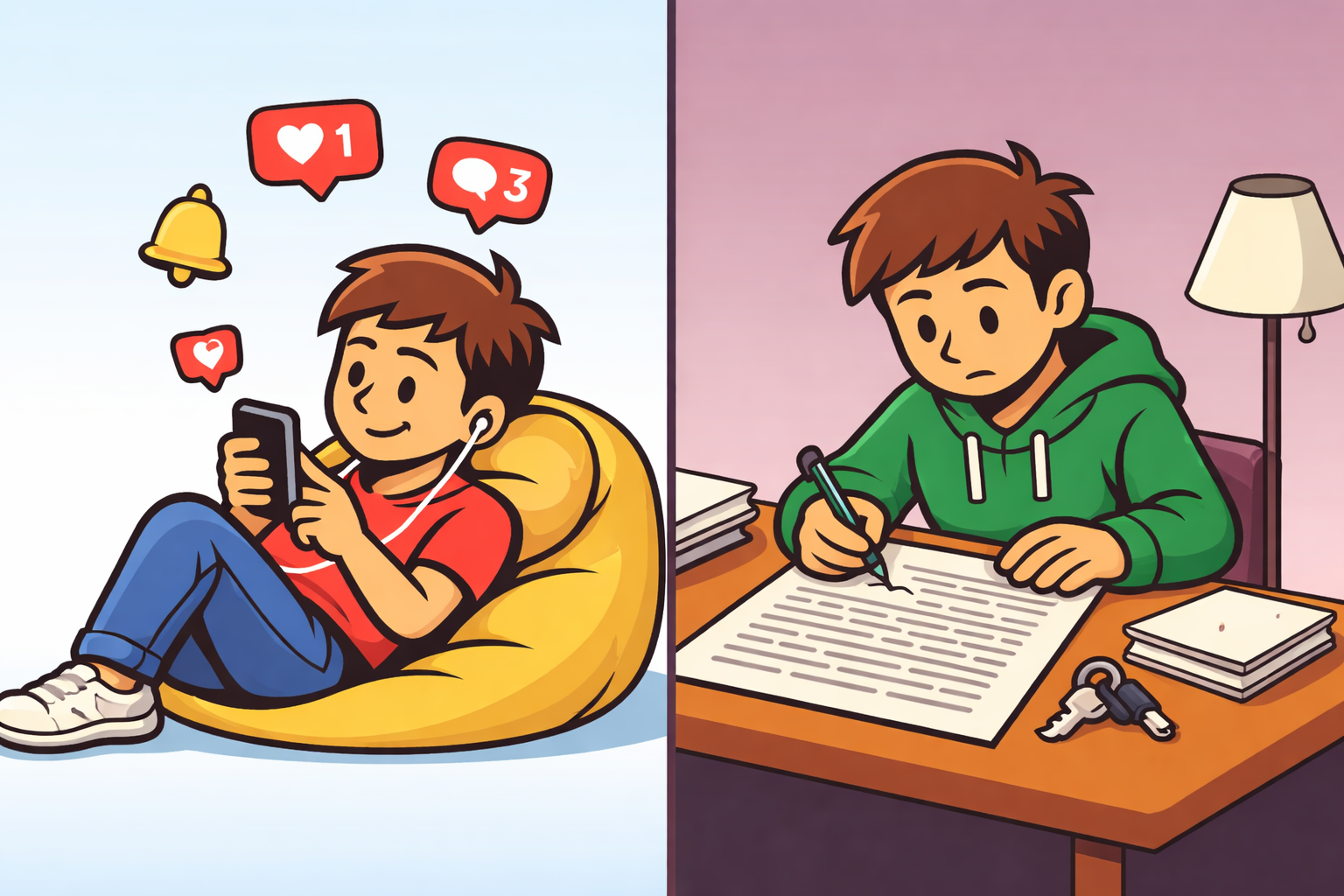
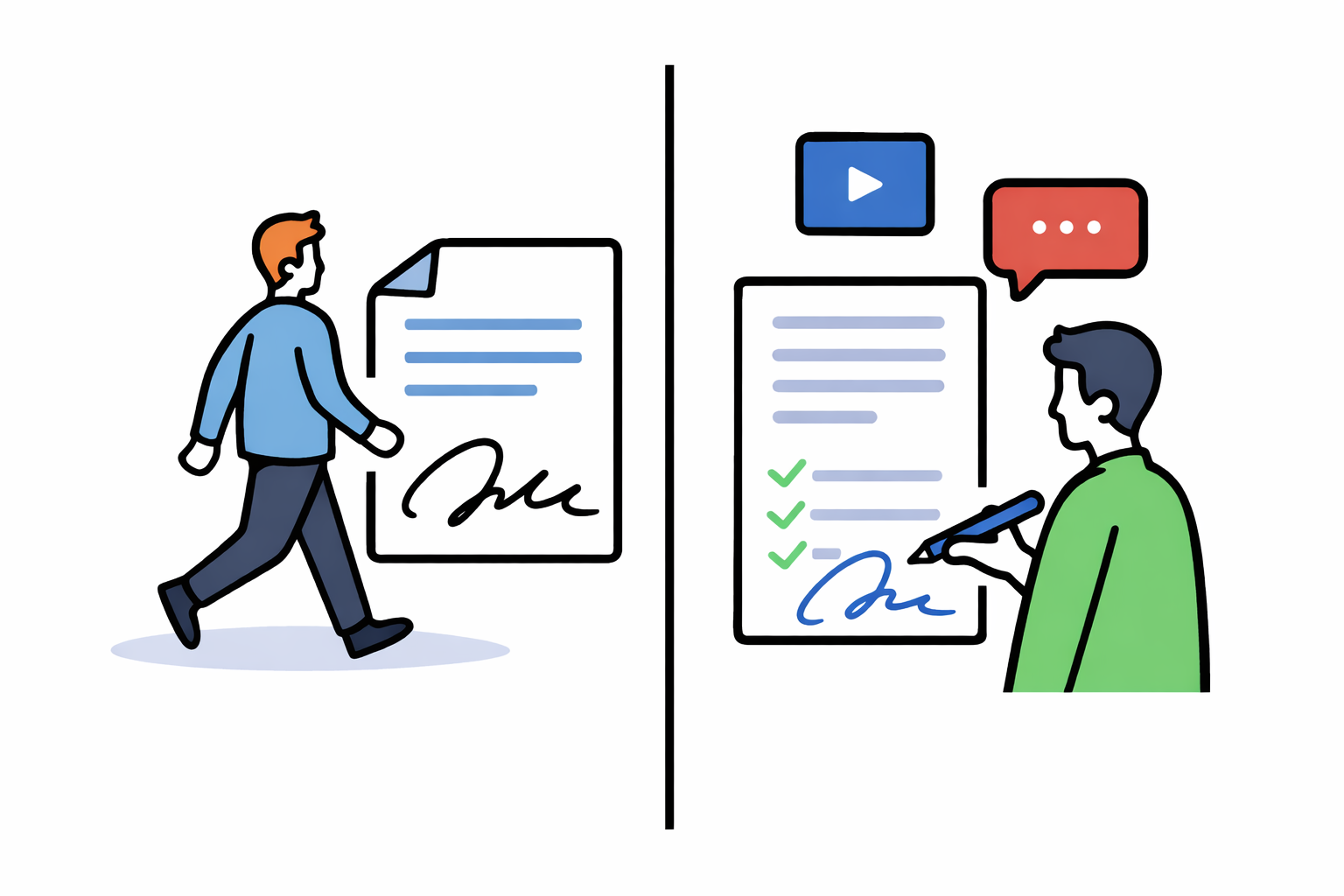
Over the past decade, electronic signature platforms like DocuSign have made it quick and easy to send, sign and return documents online. But most of these tools focus on getting a signature, not on making sure the signer truly understood what they agreed to. At the same time, studies show that most people skip reading long legal documents online. People often scroll straight to the end and click “agree” without absorbing the details. This raises an important question: does simply capturing a signature prove that the person understood the agreement? Below are twelve ways  i agree goes beyond traditional e-sign tools to improve how digital agreements are explained and accepted.
What this blog contains
- 1. Why a digital signature does not prove understanding
- 2. Why IP address evidence is weak proof of identity
- 3. Why context is often lost in signing workflows
- 4. How behavioural science can improve digital agreements
- 5. Why most people do not read terms before signing
- 6. Why agreements should match how people consume information today
- 7. Why digital agreements need to work for younger generations
- 8. How stronger audit trails improve evidence of informed consent
- 9. Why bulk signing increases the risk contracts are not read
- 10. Why regulators are increasingly focused on informed consent
- 11. How clearer agreement processes reduce disputes
- 12. Why the future of agreements goes beyond signatures
- Comparison: i agree vs traditional e-signature platforms
- Is i agree a DocuSign alternative?
- Frequently asked questions
- The future of digital agreements
1. Why a digital signature does not prove someone understood the contract
A digital signature simply shows that a signer *clicked* to accept the document – it doesn’t prove that they understood the terms. In legal terms, the-signature is evidence of acceptance, but it contains no proof of comprehension. As one analysis notes, e-signature platforms like DocuSign were “built to collect signatures quickly, not to confirm understanding”. In other words, the process records the final “yes” but not *how* the signer arrived at that decision. (For more on this idea, see our article on informed consent beyond signatures.)
2. Why IP address evidence is weak proof of identity in e-signature platforms
Many e-signature systems rely on an IP address log and email timestamp as proof of who signed. However, IP addresses can be easily masked or shared. People often work behind VPNs or corporate networks, or on shared devices, meaning a signer’s IP address may not uniquely identify them. In a world of remote work and hotspot networks, using IP alone is a brittle identity signal. In contrast, our platform ties consent to the individual through stronger checks (such as biometric or voice verification) and an audit trail of the user’s interaction (see How i agree Works). This ensures the consent is linked to a real person, not just a digital footprint.
3. Why context is often lost in signing workflows
In a standard e-sign workflow, all the supporting context is discarded once the document is signed. The final contract file (the signed PDF) shows only the terms and the-signature – it doesn’t include any of the explanations, summaries, or Q&A that the signer experienced. In practice, people reach agreements only after explanations, questions, and reviewing summaries, but traditional tools ignore that journey. As our Context Contracts article explains, “the signed document records consent, but not the journey to consent, leaving a dangerous blind spot”. In short, contracts capture the what of the agreement, but not the how, and that missing context is exactly where misunderstandings take root.
4. How behavioural science can improve digital agreements
Simple design changes can make contracts far more understandable. Behavioural science shows that involving people actively and multisensorially boosts retention and comprehension. For example, the “production effect” means people remember information better if they speak it aloud. i agree uses this by having signers repeat key terms out loud (via a recorded script), turning passive reading into active engagement. Likewise, combining words with visuals or audio helps comprehension (dual-coding theory). Our platform automatically generates short summary scripts and explainer slides for each contract, and even highlights key points – techniques proven to boost engagement. These built-in design elements help ensure important information isn’t hidden in legalese but presented in user-friendly ways (for more, see our behavioural science blog).
5. Why most people do not read terms before signing
Research consistently finds that almost no one reads long contracts carefully. In one study, over 90% of people accepted terms and conditions without reading them. Our own analysis similarly notes that “most people do not read full contracts” – they tend to scan quickly or skip to the-signature. In the online world, the opportunity to read is often an illusion. People are busy and will sign to move forward, assuming any unexpected terms will be reasonable. The result is a compliance tick-box, not an informed agreement. This is why true consent cannot be assumed from a quick click.
6. Why agreements should match how people consume information today
Most e-sign systems still present agreements as dense, linear PDFs – yet modern digital content is very different. Marketing and news have shifted to short, scannable, multimedia formats, but legal contracts often lag behind. In other words, contracts tend to be “dense, text-heavy, linear,” even as communication elsewhere is bite-sized and multi-format. People today expect information in chunks, with clear headings, highlighted text, or even videos. That means agreements should too. In practice, i agree breaks a contract into clear sections with plain-language summaries, definitions, and short explainer videos – meeting signers on their own terms. By aligning with how people learn (skimming headers, watching short clips, answering quick questions), agreements become far more accessible than a traditional PDF dump.
7. Why digital agreements need to work for younger generations
Digital natives who grew up on YouTube, TikTok and instant messaging often treat contracts as another quick click. Studies suggest Gen Z is especially prone to skipping long text – in one survey about a third admitted they never fully read contracts, and many later faced hidden fees or surprises. Younger users expect simple, interactive formats, not dense PDFs. By using video explainers, voice confirmations and chat-like Q&A within the flow, i agree meets them where they are. This more conversational approach is critical if everyone – including Gen Z – is to absorb the key points before agreeing.
8. How stronger audit trails improve evidence of informed consent
Traditional e-signatures only record a timestamp and a signature image. i agree does far more. Every step of the flow is logged: which summary video was shown, which glossary entries were opened, what questions were asked, and exactly what the person said in their confirmation. The platform then produces a sealed record with two linked documents: one for your records and one for the client’s. The full audit trail “shows not just the intent, but every component of the informed decision” – including the video they saw, the audio recording they made, transcripts of what they repeated, and how long they spent on each part. This provides compelling proof that the client understood and freely gave consent, not just that they clicked a box.
9. Why bulk signing increases the risk that contracts are not read
Bulk signing lets users apply one-signature to dozens of agreements at once. While efficient, it massively multiplies the chance that each document was not actually read or understood. One-click “Sign All” flows encourage people to breeze through agreements without pausing. This convenience makes “signing blind” even more common. That’s why i agree treats each agreement individually, with no bulk-sign option – ensuring users must at least see and acknowledge each contract’s key points before completing it.
10. Why regulators are increasingly focused on informed consent
Regulators now expect firms to ensure customers really understand what they sign. For example, the UK’s Financial Conduct Authority (FCA) and Solicitors Regulation Authority (SRA) have made it clear that businesses must ensure people understand what they’re signing up for. In practice this means “clarity must come before consent” – key information must be easy to find and explainable. Under the FCA’s new Consumer Duty, firms must demonstrate that important disclosures were delivered clearly and confirmed by the customer, not just buried in fine print. In short, signatures alone are no longer enough: regulators expect proof of understanding, not just a tick-box.
11. How clearer agreement processes can reduce disputes later
Confusion over contract terms drives complaints and disputes. If clients misunderstand their commitments or fees, they will complain or even take legal action. For instance, the UK’s Financial Ombudsman reports about 165,000 new complaints a year, many from customers who “didn’t understand” something in their agreement. In fact, roughly one in three such disputes is resolved in the customer’s favor precisely because the firm cannot prove the customer was adequately informed. By creating a transparent, clear process up front, i agree helps avoid this “he said, she said” conflict. Clients see the key terms, can ask questions, and confirm understanding in real time – reducing surprises and post-signing grievances (see also our guide on reducing complaints and disputes).
12. Why the future of agreements goes beyond signatures
Electronic signatures were a huge step forward in digitizing contracts, but they only capture the-signature itself – not understanding. The next step is making sure that signatures reflect informed consent. As we argue in our Informed Consent guide, a signature “might tick the legal box today, but it will not hold up in a world where informed consent becomes the norm”. The industry is clearly moving in that direction: agreements must become more conversation-like, built around client comprehension. In short, e-signatures replaced the pen on paper; now we need a new paradigm that replaces confusion with clarity, which is exactly what i agree is designed to provide.
i agree vs traditional e-signature platforms
| Feature | Traditional e-signature platforms | i agree |
|---|---|---|
| Primary focus | Capturing a signature quickly | Demonstrating understanding of key terms |
| Identity evidence | IP address and email trail | Confirmed engagement with the agreement |
| Key terms | Buried in long documents | Clearly summarised up front |
| Behavioural design | Minimal (designed for speed) | Built-in (multimedia, interaction, memory aids) |
| Bulk signing | Common (many docs signed at once) | Not allowed (each agreement treated individually) |
| Evidence of understanding | Limited (basic audit log) | Rich (video/audio records, transcript, questions answered) |
Is i agree a DocuSign alternative?
Many organisations searching for digital agreement tools start by looking at DocuSign. DocuSign and similar platforms excel at helping organisations send and sign documents online efficiently. However, they are primarily built to *execute* documents, not to ensure understanding. i agree is designed for the next step: improving how contracts are understood before they are signed. Instead of focusing only on execution, i agree focuses on communication. Key differences include plain-language summaries of key terms, interactive explainers, and design elements that encourage user engagement. We link the explanation and acceptance together and treat each contract as an individual decision (no “sign all” button). In short, if DocuSign’s strength is execution efficiency, i agree’s strength is proof of comprehension. See our comparison page for more details.
Frequently asked questions about digital agreements and e-signatures
Are e-signatures legally binding? In general, yes. Laws like the US ESIGN Act and UETA, as well as the EU’s eIDAS regulation, grant electronic signatures the same legal validity as handwritten ones. That means a signed PDF or agreement is usually enforceable in court just like a paper signature. However, it’s crucial to remember: a signature only proves the person agreed to something; it does not prove they understood the content.
Do people actually read terms and conditions? Almost never. Research consistently shows that most people do not read long contracts in full, especially online. For example, one study found over 90% of users accept terms without reading them. In practice, clients tend to scroll to the end and click “agree” to proceed. In most cases, agreements are signed in seconds, so a signature often isn’t evidence of understanding.
What is the difference between a digital signature and informed consent? A digital signature is simply a mark or click indicating acceptance of a document. Informed consent goes further: it means the person clearly understands the key terms before agreeing. A signature only shows agreement, while informed consent shows understanding. In other words, one signals that the button was clicked, whereas the other requires confirming that the signer saw and comprehended the important points. Proving informed consent usually means recording interactions (summaries, explanations, confirmations) leading up to the-signature.
Why can bulk signing be risky? Bulk signing (applying one-signature to multiple agreements at once) increases the chance that people sign without reading. With bulk signing, recipients typically see a list of documents and sign all as a batch, often out of convenience. This compounds the unread-contract problem: if one agreement went unread, dozens might. i agree avoids this by treating each agreement individually, so signers must engage with each contract’s content before accepting it.
How can businesses improve digital agreement processes? Many are exploring ways to present contracts more clearly and interactively. This can include adding plain-English summaries or Q&A steps before the-signature, using audio or video explainers for complex points, and allowing recipients to ask questions within the signing flow. For example, starting with a “Key Facts” summary (like a customer facts panel) helps orient users to the important terms. In general, focusing on transparency and user understanding (rather than just legal formality) has been shown to reduce downstream complaints and disputes. See our resources on reducing complaints for more strategies.
The future of digital agreements
Electronic signatures revolutionised how we execute contracts online. But the next challenge is ensuring people truly understand what they agree to. As we describe in our article on the future of agreements, modern contracts should feel “like a conversation, not a hurdle”. Digital interactions will only become faster and more automated, so the need for clear communication around agreements will grow. Platforms like i agree are designed for this future: they capture not just a signature, but evidence that the person was informed and gave consent knowingly. The goal is to build trust from the start, rather than managing disputes later.
References
Internal links:
- Clear Communication: Reducing Complaints and Disputes – discusses how improving contract clarity and transparency reduces customer complaints and disputes.
- Our Principles – outlines i agree’s design philosophy, including use of video, voice, and plain language to improve understanding.
- Frequently Asked Questions – covers legal binding of e-signatures, the production effect, and evidence of consent (including UK/EU law).
- How i agree Works – details the step-by-step workflow, including summaries, recordings, and enriched audit trails.
- Informed Consent: Understanding Beyond Signatures – explains why a signature alone isn’t enough and how to demonstrate true understanding.
- The Context Contracts – describes the gap between a signed agreement and the signer’s understanding, and introduces the “context contract” idea.
- The Future of Agreements (Voice & Video Consent) – on using voice or video to capture consent in a way people find natural, improving clarity and auditability.
- 6 Behavioral Science Insights – a blog post covering psychology principles (like the production effect and dual coding) that improve communication.
- Why People Don’t Read Contracts – a blog explaining how most clients skip reading contracts and how to redesign them for comprehension.
- E-sign Tools Won’t Tell You if Clients Understand – a blog describing how standard e-sign workflows fail to confirm comprehension and giving survey stats.
- Compare us to e-Signatures – a solution page comparing i agree to traditional e-signature platforms and highlighting key differences.
External links:
- Are E-Signatures Legally Binding? (SafeDox) – explains UK/EU law on e-signatures (Electronic Communications Act, eIDAS) and confirms they carry the same weight as handwritten signatures.
- E-signature for legal documents (eSignGlobal) – covers international e-signature laws, noting that US laws (ESIGN, UETA) and the EU eIDAS make electronic signatures legally equivalent to handwritten ones.
- Electronic Signature Legality (BoldSign) – notes that e-signatures are legally binding in “60+ countries, including the U.S., UK, and EU, under laws like ESIGN and eIDAS”.