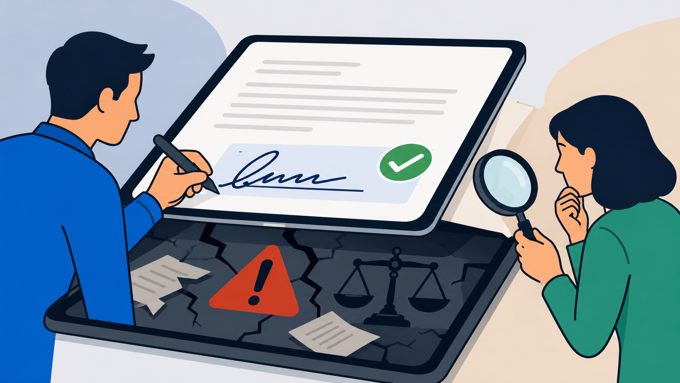
Rising SRA reports show why client understanding matters
Contract News
Recent News
Reducing Disputes
20/05/2026
15 min read

22 May 2025
4 min read

The UK’s new Consumer Duty has introduced a tougher benchmark for how financial services communicate with customers. One of its key pillars is Consumer Understanding, outlined in Section 8 of the FCA’s finalised guidance (FG22/5). It asks a crucial question:
Do your customers genuinely understand what they’re agreeing to?
The FCA’s intention is clear:
"Firms should support consumer understanding by presenting information in a way that helps consumers make effective, timely and properly informed decisions" (FG22/5, 8.1)
The guidance outlines several specific expectations:
In short, it’s no longer enough to deliver a dense document and collect a signature. Firms must show that they have genuinely helped the customer understand — and have evidence to prove it.
This isn’t just a theoretical shift, it addresses real-world issues:
If your business still relies on traditional PDFs, long disclosures or standard e-signature flows, you may already be out of step with regulatory expectations.
Meeting the FCA’s Consumer Understanding outcome doesn’t mean tearing up your processes. But it does mean rethinking how information is delivered.
Here are some practical ways to align with the guidance:
These steps can sound time-consuming or technically complex. But they don’t have to be.
 i agree helps you do it all
 i agree was built to help firms meet the Consumer Understanding outcome, without having to completely redesign their processes or tech stack.
Here’s how it works:
With i agree, you don’t need to piece together multiple tools or rebuild your workflows. Everything is handled in one clear, compliant process.
The FCA is asking firms to go beyond disclosures and focus on real comprehension. That might sound like a big shift but it’s also a major opportunity.
By improving how you communicate and prove understanding, you not only meet the Consumer Duty, you earn your customers’ trust.
Consumer Understanding is part of the FCA’s Consumer Duty. It means firms must communicate in a way that helps customers make informed decisions. The focus is not just whether information was provided, but whether it was clear, timely, relevant, and understandable.
It matters because customers often sign or accept terms without fully understanding them. Poor communication can lead to complaints, disputes, regulatory scrutiny, and loss of trust. The FCA now expects firms to support real comprehension, not just collect signatures.
Firms can use plain English, layered summaries, highlighted key risks, accessible formats, interactive prompts, and opportunities for questions. They should also keep evidence showing what the customer saw, asked, and confirmed before agreeing.
Not always. A PDF or e-signature can show that information was sent and accepted, but it may not prove the customer understood it. Firms need a process that actively supports understanding and creates a stronger audit trail.
i agree help with Consumer Understanding?
i agree uses video summaries, plain-language explanations, highlighted key terms, Q&A, spoken confirmation, and a full digital record. This helps firms explain agreements clearly and evidence that the customer engaged with the information before consenting.
Firms should keep a clear record of what was shown, when it was shown, what questions were asked, what answers were given, and how the customer confirmed understanding. This evidence can support compliance and reduce dispute risk.