Why every e-signature could soon be contestable
e-Signatures
Future of agreements
Legal disputes
19/05/2026
13 min read

18 November 2025
20 min read
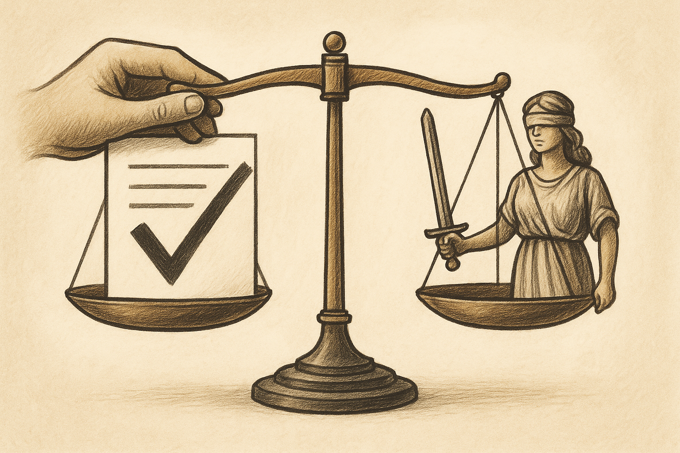
“Marking your own homework” is a British saying that means acting as both judge and jury in your own case. In business, it happens when a company controls every aspect of a process that customers are supposed to trust. If you build your own e-signature or approval tool and run the entire agreement process internally, you’re essentially grading your own exam. It might feel efficient, but it raises a critical question: will anyone else trust the result?
When a business manages the contract wording, the customer’s signing journey, and the “I agree” button all on its own platform, it removes a neutral perspective. Clients could worry that the deck is stacked in the company’s favor. In an age where trust in digital processes is paramount, being both the author and validator of your agreements can erode client confidence. This blog explores why impartial, third-party verification matters for agreements and how independent solutions build trust.
What this blog contains:
 i agree Is Different
Many companies are tempted to create their own signing or approval systems. On the surface, it seems convenient. You can tailor the workflow to your needs, avoid third-party fees, and keep everything under one roof. However, when a business builds an independent signature platform for itself (i.e., an in-house tool that isn’t truly independent at all), it runs into a credibility problem. The business controls the contract content, how it’s presented, how the client gives consent, and how that consent is recorded. In effect, the company is “marking its own homework” by vouching for an agreement in which it has a vested interest.
Think about it from a client’s perspective. If an organization sends you a document through its own proprietary system and says “just click here to approve,” would you wonder if the process is fair? The client might fear that the company’s system could be logging consent without proper transparency, or that it might not record any dissent. Because the business has built the tool, the client has no independent witness to verify what actually happened. This lack of a neutral party can breed skepticism. No matter how well-intentioned the company is, a process controlled entirely by one side can feel like the honor system – and not everyone will trust it.
In contrast, when agreements are handled through a neutral, third-party verification for agreements, there’s an implicit layer of trust added. The platform itself serves as an impartial checkpoint, assuring both sides that the agreement was presented and captured fairly. Without that, a company’s in-house solution may save time but at the cost of client confidence. It’s the classic convenience vs. trust trade-off. And as we’ll see, trust is not something most businesses can afford to compromise.
Impartiality is more than just a nice-to-have in agreements – it’s the bedrock of trust. When one party has total control over an agreement process, there’s an inherent conflict of interest. Even if that party acts fairly, the other side may still question the outcome. An impartial signature solution introduces a neutral layer that assures everyone the process is above board. Here’s why that matters:
Ultimately, impartiality in the agreement process signals respect for the client’s autonomy. It tells clients, “We’re confident enough in our terms and our process that we’re willing to have an outside system verify your consent.” That transparency and humility can turn a skeptical client into a loyal one. Trust, once broken, is hard to rebuild – so smart businesses design their processes to get it right the first time, with neutrality built in.
The concept of avoiding “marking your own homework” isn’t unique to digital signatures. Across industries and aspects of life, we routinely rely on independent checks to build trust. Let’s look at a few examples that highlight how third-party validation trumps self-approval:
All these examples share a common theme: impartial verification builds trust. Whether it’s finances, academics, consumer products, or digital transactions, we feel more comfortable when a neutral party is part of the process. It’s a proven concept in the real world that readily applies to digital agreements and signatures. If you wouldn’t trust a five-star rating given by a company to itself, why would you trust an important contract that a company “approved” using its home-grown tool? The stakes with contracts are often much higher, so the need for neutrality is even greater.
Running your own agreement or signature system internally might offer control, but it comes with significant risks. These aren’t just hypothetical problems – they can lead to real financial and legal pain. Here are some key risks businesses face when they act as the sole authority over their contract approvals:
In summary, an in-house approval mechanism might give a company full control, but it also inherits full liability for any shortcomings. Bias – real or perceived – and lack of independent verification make it fragile in the face of disputes. The very act of controlling everything can backfire; if something is questioned, you have no external support to validate your claims. It’s a lonely position to be in when a high-stakes agreement is on the line. This is why many organizations, after some close calls, realize the cost of an impartial solution is far less than the cost of a mistrusted or failed agreement process.
Now that we’ve looked at the risks of going it alone, what about the flip side? What do businesses and clients gain by using an impartial, third-party platform for signatures and agreements? The benefits go well beyond just “it works.” They tie directly into business reputation and outcomes:
In summary, choosing an impartial platform for digital agreements isn’t just about avoiding negatives; it actively creates positives. It builds a foundation of trust before, during, and after the moment of signing. Clients feel more comfortable, stakeholders see your processes as credible, and your team gets solid backup in case of any challenges. In a world where one bad experience can go viral or one compliance slip can incur hefty fines, these benefits are not just theoretical – they’re a strategic advantage.
i agree Is DifferentSo where does i agree fit into all this? Throughout this discussion, we’ve emphasized the need for impartial, trust-building solutions. i agree is an example of exactly that kind of platform – an independent consent platform built to ensure neutrality, understanding, and robust evidence in digital agreements. But importantly, it’s not just about slapping a third-party logo on a signature; it’s about rethinking how agreements are captured altogether.
Unlike a typical e-signature tool that simply digitizes a “scribble” or a checkbox, i agree was designed to eliminate the “marking your own homework” problem and raise the bar for clarity. It functions as an impartial intermediary between businesses and their clients, ensuring neither side has undue control over the process. Here’s how i agree builds trust through independence and innovation:
i agree approaches consent as something to be earned through clarity, not coerced through fine print. Clients using i agree aren’t just presented with a wall of text and an “Accept” button. They are guided with plain-language summaries of key terms, and even short videos or audio explanations for complex points. The platform might prompt the user to confirm understanding of crucial details (for example, by asking a simple question or having them acknowledge a specific term). This ensures that what’s being “agreed” to is truly understood. The magic here is that i agree independently verifies that the client got the information clearly – it’s not left to the business to claim “we told you so.” The trust in digital signatures increases dramatically when the signature is accompanied by proof of comprehension. i agree is recorded impartially. It’s not a company representative taking notes; it’s the platform automatically creating an audit trail. This includes timestamps for when the client watched the explainer video, when they scrolled through the terms, when they provided their consent, and even a record of their spoken or video confirmation (since i agree allows voice and video consent). The result is a rich, neutral evidence package. If later someone says, “I never knew about X clause,” the platform can produce the exact moment the user acknowledged that clause, perhaps even in their own voice. It’s hard to argue with that level of independent, factual detail. It’s like having a trusted witness in the room for every agreement, one that both the company and the client can rely on. i agree, the business doesn’t get to cherry-pick what the client sees or skip over uncomfortable details. The platform standardizes the experience to ensure fairness. For instance, if there’s a particularly important risk or fee in the contract, the system can force that to be highlighted or explained, so it’s never glossed over. From a client’s viewpoint, this is huge for trust – they feel the platform “has their back” by not letting critical points hide in legal jargon. From the business side, it actually builds credibility: clients see that the company is willingly using a system that calls attention to all key facts (good or bad). That transparency can differentiate a business as honest and customer-centric. i agree, businesses are effectively saying, “Don’t just trust us – trust the independent platform to capture this deal correctly.” It functions as a third-party verifier of the agreement’s integrity. For sectors like finance or legal services, this is a breath of fresh air. It aligns with emerging regulations that demand proof of customer understanding. Instead of the company later scrambling to prove they did the right thing, the proof is captured by i agree in real time. Internally, compliance teams love this because it’s far more foolproof than relying on staff to log interactions manually. Externally, clients appreciate the consistency. i agree, integration is actually smooth – it can plug into a company’s website or CRM, so from the client’s perspective it feels seamless. They might be on your site or app, but the crucial consent steps are powered by i agree under the hood. This means companies don’t sacrifice user experience to gain impartiality. It’s the best of both: a smooth digital journey that’s unbiased. And because i agree is handling the critical consent pieces, clients end up feeling a greater sense of security and clarity, even if they don’t consciously realize why. i agree is positioned as a smart enhancement to the client experience, not a replacement of the company’s role. The agreement still involves the company’s name and details; it’s just facilitated by an impartial helper. It’s analogous to how using a secure checkout doesn’t make a customer think less of an online store – if anything, it makes them think, “This store cares about my security.” Similarly, using i agree shows clients, “This business cares that I truly understand and freely consent.” That’s a powerful message that can set you apart in any industry where competitors might still be pushing PDFs and unchecked boxes.In essence, i agree exists to provide independent clarity in agreements, not just to capture a signature. It was born from the very recognition that marking your own homework is a flawed approach in the era of informed consumers and strict regulators. By acting as a neutral ground for agreements, it helps businesses and clients find common truth – a shared understanding documented by a third party. When an agreement journey is handled this way, it stops feeling like a rubber-stamp exercise and becomes a moment of genuine agreement. That’s the difference: instead of a rushed click, you get a meeting of minds, facilitated by an impartial platform that both sides can trust.
As industries evolve and the demand for transparency grows, solutions like i agree demonstrate that doing the right thing (being open and unbiased) is not only ethical but also smart business. Trust is hard to earn and easy to lose. By avoiding the trap of marking our own homework, and embracing independent solutions, we set the stage for trust-filled client relationships and agreements that truly stick.
Internal links
External links
It means a company controls the entire process and also validates the outcome. In agreements, this happens when a business creates, delivers, and records consent within its own system, raising questions about whether the process is truly fair or impartial.
When a company controls everything, clients may question whether the process is unbiased. Even if the system is fair, the lack of independent oversight can create doubt about how consent was captured and whether key terms were presented clearly.
Impartiality builds trust by ensuring both sides rely on the same evidence. A neutral platform provides transparency, reduces perceived bias, and creates a record that can be trusted by clients, regulators, and dispute handlers.
Risks include weaker audit trails, perceived bias, reduced credibility in disputes, and potential compliance issues. If a disagreement arises, the business may struggle to prove fairness when it controlled the entire process.
Independent platforms provide neutral records, clearer evidence, and stronger audit trails. They help ensure key terms are presented fairly and reduce disputes by showing what was explained and what the client confirmed.
i agree different from standard e-signature tools?
i agree focuses on informed consent, not just signatures. It captures explanations, confirmations, and evidence of understanding, creating an impartial record of what the client saw and agreed to, rather than just a record of a click.