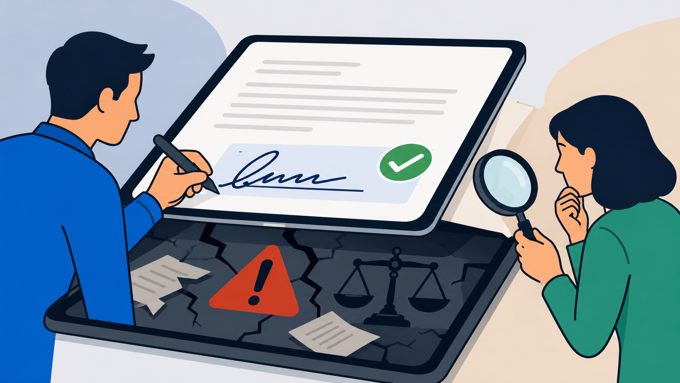
Why every e-signature could soon be contestable
e-Signatures
Future of agreements
Legal disputes
19/05/2026
13 min read

05 May 2026
15 min read
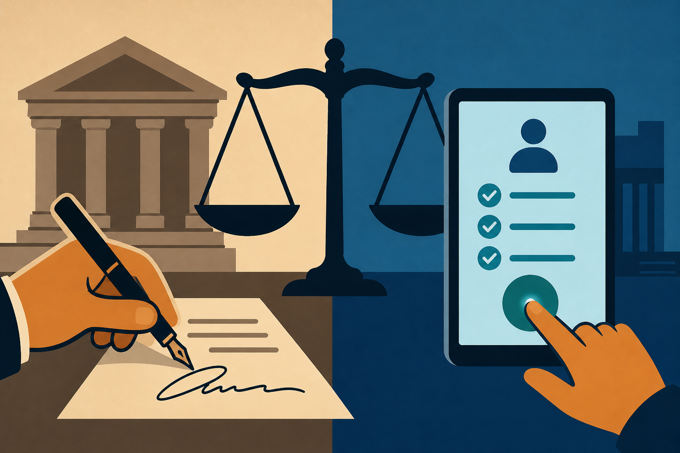
For a long time, the safest answer in contract disputes was simple: did they sign? If the answer was yes, the business usually felt protected. A wet ink signature, and later an e-signature, became the final line of defence. It was treated as proof that the person agreed.
But I think that answer is starting to look too thin. Not because signatures are worthless. They are not. UK law still recognises signatures and electronic signatures. The issue is different: a signature proves an act, but it does not always prove understanding.
That distinction is becoming more important in the courts, in regulation, and in customer complaints. The question is shifting from “Did they sign?” to “What were they shown, how was it explained, and can you prove they understood the important parts?”
This is where the idea of informed consent beyond signatures becomes much more than a compliance phrase. It becomes the future evidence standard for agreements. And it is why context contracts could become one of the most important developments in how businesses prove consent.
I am not saying every signed agreement is about to become invalid overnight. That would be wrong. The stronger argument is that bare signatures are losing evidential power, especially where there are hidden fees, conflicts of interest, unusual clauses, vulnerable consumers, professional fees, financial products, or regulated advice.
In that future, the strongest agreement will not simply be the one with the fastest e-signature. It will be the one with the best record of understanding. That is the future  i agree is building towards.
The starting point is still the old rule: if you sign a contractual document, you are usually bound by it. That principle comes from L’Estrange v F Graucob Ltd [1934].
In that case, the court said that where a party signs a contractual document, it is generally “wholly immaterial” whether they have read it. That is the classic signature rule. It is still the baseline many businesses rely on today.
Key takeaway: a signature is powerful evidence of agreement. But it is not perfect evidence of understanding.
That matters because the law has never been as simple as “signed means safe.” Even from the beginning, there were exceptions: fraud, misrepresentation, mistake, non est factum, unfair terms and failure to properly incorporate certain clauses. The modern cases have not abolished L’Estrange. They have done something more subtle: they have chipped away at the idea that a signature alone answers every question.
That is why the strongest businesses are already moving towards evidence that signatures alone cannot provide: what the person saw, what they were told, what they asked, what they confirmed, and how the key risks were brought to their attention.
The phrase “it was in the terms and conditions” used to feel like a strong defence. Today, it is often only the beginning of the argument.
The courts have repeatedly shown that important, unusual or damaging terms need more than passive disclosure. If a business hides a major financial consequence in a dense document, it may struggle to show that the person genuinely agreed to that specific consequence.
This does not mean every clause must be explained line by line. It means the higher-risk parts of the agreement need to be surfaced properly. Cancellation fees, success fees, commission arrangements, exclusions of liability, automatic renewals, data use, withdrawal rights, limitation clauses and conflicts of interest are obvious examples.
The practical point is simple: the more serious the consequence, the stronger the evidence of understanding needs to be.
This is exactly where a contract transparency and consent audit trail becomes valuable. It gives a firm evidence that the key terms were not merely available somewhere in a PDF, but actively presented in a way the customer could engage with.
L’Estrange v F Graucob is the starting point for any history of signatures in the courts. A signed document was treated as binding even though the person signing had not read the terms.
Key takeaway: the law started with the assumption that a signature binds you.
Why it matters now: L’Estrange is the rule businesses still lean on. But the rest of this history shows why relying on it alone is increasingly risky.
In Curtis v Chemical Cleaning, the customer signed a document after being told the clause only covered damage to beads. In reality, it was much wider. The court would not let the business rely on the broader exclusion.
Key takeaway: if the explanation is misleading, the signature is weakened.
Why it matters now: consent is only as good as the communication that produced it. If a customer is told one thing but the contract says another, the signature may not save the business.
Thornton v Shoe Lane Parking gave us Lord Denning’s famous “red hand” idea. A particularly onerous clause may need to be printed in “red ink with a red hand” or brought to attention in an equally clear way.
Key takeaway: unusual or harsh terms need special attention.
Why it matters now: a major clause cannot be treated like background noise. If it changes the customer’s rights in a serious way, the business should be able to prove it was highlighted.
In Interfoto v Stiletto, a very high holding fee was hidden in standard delivery terms. The Court of Appeal held that it had not been properly incorporated.
Bingham LJ’s point is still one of the best summaries of the law: “the more outlandish the clause, the greater the notice” required.
Key takeaway: a harsh clause needs active signposting.
Why it matters now: this is the logic behind modern consent journeys. A fair system should identify the clauses most likely to surprise the customer and make sure they are properly explained.
In OFT v First National Bank, Lord Bingham described good faith in consumer contracts as “fair and open dealing”. He also said terms should be expressed clearly and contain “no concealed pitfalls or traps.”
Key takeaway: consumer terms need openness, not clever drafting.
Why it matters now: this is the foundation of a better agreement process. The aim should not be to win through fine print. It should be to create a record that the customer understood the real commercial effect of the agreement.
ParkingEye v Beavis is useful because it shows the other side of the argument. The parking charge was upheld, and one reason the case is important is that the charge was clearly displayed on signs.
Key takeaway: prominent terms are more defensible than hidden ones.
Why it matters now: the lesson is not that all charges are fine. The lesson is that visibility matters. If a term is important, show it properly.
Spreadex v Cochrane is one of the strongest cases for online agreements. A customer had clicked to accept online terms, but a serious liability clause was buried in a long customer agreement. The court said it would have been close to “a miracle” if the customer had read and appreciated it.
Key takeaway: clickwrap proves a click. It does not always prove informed consent.
Why it matters now: e-signature platforms and tick boxes often record the final action but not the understanding behind it. That is the gap a proper e-signature alternative focused on informed consent is designed to close.
In Blu-Sky v Be Caring, a supplier tried to rely on a large cancellation charge hidden in standard terms. The court described the clause as “cunningly concealed” in a dense thicket of wording.
Key takeaway: even in business contracts, hidden high-impact terms may fail.
Why it matters now: the risk is not limited to consumers. If a term has a major financial consequence, burying it in linked terms is a weak strategy.
Herbert v HH Law is one of the clearest cases for the legal sector. The Court of Appeal held that client approval of a success fee meant approval after a “full and fair explanation.” The burden was on the solicitor to show informed consent.
Key takeaway: professional firms may need to prove the client understood the financial consequences.
Why it matters now: for law firms, client care letters and signed CFAs are not the whole answer. A stronger process records the explanation, the key fee terms, and the client’s confirmation that they understood them. This is why law firm consent journeys are becoming more important.
Belsner v CAM Legal Services needs careful wording. The solicitor won the appeal, so it should not be presented as a simple consumer victory. But the judgment still matters because the Court of Appeal said the solicitors had not complied with professional duties to give the client the best possible costs information or put her in a position to make an informed decision.
Key takeaway: winning technically does not mean the communication was good enough.
Why it matters now: Belsner is a warning. If the client later says they did not understand the fee structure, the firm needs more than a signed document. It needs evidence of the explanation.
Montgomery v Lanarkshire is a medical case, but the principle is powerful. The Supreme Court moved the law of patient consent towards dialogue, material risks and reasonable alternatives.
Key takeaway: informed consent means understanding the risks and options, not simply signing a form.
Why it matters now: the concept is spreading beyond healthcare. In finance, legal services and other regulated sectors, businesses are being expected to communicate in a way the person can actually understand.
The Johnson v FirstRand motor finance litigation is one of the most important recent cases for this debate. The Supreme Court narrowed the Court of Appeal’s approach, so it should not be exaggerated. The broad bribery and fiduciary arguments failed. But Mr Johnson still succeeded under the Consumer Credit Act unfair relationship provisions.
The Supreme Court pointed to factors including the size of the commission, the false impression created by documents, lack of prominence, and the fact that Mr Johnson was commercially unsophisticated.
Key takeaway: partial or unclear disclosure can still create serious risk where the overall relationship is unfair.
Why it matters now: this is not just about motor finance. It is about the evidence standard for consumer understanding. If there is a commission, conflict, fee or financial consequence, the business needs to prove meaningful disclosure, not just technical disclosure. This is especially relevant for motor finance claims compliance and informed consent.
Electronic signatures are legally recognised in the UK. The Law Commission’s work on electronic execution confirms that an electronic signature can be used to execute a document where the person intends to authenticate it and any required formalities are satisfied.
Cases such as Bassano v Toft and Neocleous v Rees show that courts can be flexible about what counts as a signature. Clicking “I accept” may be enough. An email footer may be enough. A typed name may be enough.
But that is exactly the problem.
If almost anything can count as a signature, then the signature itself becomes less interesting. The real dispute becomes: what did that person understand when they authenticated the document?
That is why the future is not just digital signatures. The future is voice and video consent, guided summaries, question logs, comprehension prompts and time-stamped records. Not because these are gimmicks, but because they answer the questions a bare e-signature cannot answer.
The courts are not moving in isolation. Regulators are pushing in the same direction.
The FCA Consumer Duty guidance says firms should give customers the information they need, at the right time, in a way they can understand. The FCA has also made clear that firms should support effective, timely and properly informed decisions.
The SRA Code of Conduct requires solicitors to give clients information in a way they can understand and ensure they are in a position to make informed decisions about services, options, matter handling and pricing.
The CMA guidance on unfair contract terms also tells businesses not to hide important wording away or rely on small print that may surprise or mislead consumers.
The direction is obvious: regulators do not want disclosure theatre. They want customer understanding.
That is why FCA and SRA informed consent compliance is becoming a real operational issue. Firms need a way to prove that communication was clear, timely, accessible and understood. A signature on page 12 does not do that on its own.
A traditional contract records the final terms. A context contract records the journey to those terms.
That is the key difference.
A context contract does not need to replace the legal document. The original agreement can stay exactly as it is. What changes is the evidence wrapped around it.
A context contract can include:
This is the shift I think matters most. A normal contract says: “Here are the terms.” A context contract says: “Here are the terms, here is how they were explained, and here is the evidence that the person understood the parts that mattered.”
That is why i agree is not just trying to make signing faster. The point is to make agreements stronger. The i agree informed consent journey is built around plain language, key clause visibility, customer questions, voice or video confirmation and a full consent audit trail.
In a dispute, that changes the conversation. The business is no longer saying, “They signed it.” The business can say, “Here is what they were shown. Here is what was explained. Here is what they asked. Here is what they confirmed. Here is the record.”
My view is that signatures will not disappear completely. They are too familiar and too embedded in law and commerce. But their role will change.
The signature will become the final confirmation, not the whole evidence file.
In low-risk transactions, a simple tick box may remain enough. But in higher-risk agreements, especially regulated ones, the question will increasingly be whether the firm can prove informed consent. That means proving the person understood the key terms, risks and consequences before they agreed.
This is where I think the future is heading:
That is why tools like i agree could become the practical standard for enforceable high-risk agreements. Not because the law will say one specific platform must be used, but because businesses will need the type of evidence that old signing processes do not capture.
The court history points in one direction. L’Estrange told us a signature can bind. Curtis told us a misleading explanation can undo that confidence. Thornton and Interfoto told us harsh terms need special notice. First National Bank told us consumer terms need fair and open dealing. Spreadex and Blu-Sky showed the weakness of buried online terms. Herbert and Belsner exposed the need for informed decisions around legal fees. Montgomery showed informed consent is a process. Johnson showed that unclear disclosure and lack of prominence can still create unfairness.
Put all of that together and the conclusion is hard to ignore:
The legal system is not abolishing signatures. It is devaluing bare signatures.
The future belongs to agreements that can prove understanding.
Businesses do not need to wait for another court case to act. The direction is already clear enough.
Any firm relying on standard contracts, client care letters, finance agreements, claims retainers, cancellation fees, commission disclosures or complex digital onboarding should review its agreement journey now.
The questions I would ask are:
If the answer is no, the issue is not just legal risk. It is trust risk. Customers do not complain only because contracts are unfair. They complain because the agreement they remember is different from the agreement the business says they signed.
Better understanding at the start means fewer disputes later. That is why clearer agreements reduce complaints and disputes, and why consumer understanding should be treated as a business outcome, not a legal afterthought.
This is also where behavioural science matters. People do not engage well with long, dense, high-pressure documents. They respond better to layered information, plain language, repetition, audio, video and active confirmation. That is why behavioural science and contract comprehension should be part of the agreement design, not something bolted on afterwards.
i agree guide to informed consent beyond signatures — explains why understanding matters more than a simple signature. i agree context contracts and consent audit trails — explores how agreement context can be attached to the contract itself. i agree informed consent journey works — shows the process of summaries, prompts, confirmation and audit trail creation. i agree e-signature alternative for informed consent — explains the difference between collecting signatures and proving understanding. i agree for law firms and client understanding — relevant to Herbert, Belsner and legal fee explanations. i agree principles for clearer agreements — explains the platform’s approach to transparency, fairness and trust. i agree frequently asked questions — practical answers about informed consent, signatures and the platform.Yes. Signatures and electronic signatures can still be legally binding in the UK. The important point is that a signature mainly proves agreement or authentication. In higher-risk contracts, businesses may also need evidence that key terms were clear, prominent and properly understood before the person agreed.
Yes, in some situations. A signed contract can be challenged where there was misrepresentation, unfairness, hidden onerous terms, lack of proper notice, vulnerability, or failure to meet professional or regulatory duties. The stronger the evidence of explanation and understanding, the stronger the business position becomes.
An e-signature can prove that someone clicked, typed or authenticated a document. It does not automatically prove they read or understood the important terms. Informed consent needs more evidence, such as plain English explanations, key clause highlighting, question logs, recorded confirmation and a clear audit trail.
Consent means someone agreed. Informed consent means they understood what they were agreeing to before they agreed. The difference is evidence. A signature records the final action, while informed consent records the explanation, understanding, questions and confirmation behind that action.
A context contract is an agreement that carries the evidence of how it was explained and understood. It can include summaries, highlighted risks, Q&A records, voice or video confirmation and timestamps. The aim is to preserve the full decision journey, not just the final signed document.
Signatures are unlikely to disappear completely. More likely, they will become only one part of the evidence. In regulated and high-risk agreements, informed consent records may become the stronger standard because they prove what the person saw, understood and confirmed before entering the agreement.